
Circuit Breaker Keeps Tripping: Causes, Safety Steps, and Electrical Repairs in Southeastern Wisconsin
November 4, 2026
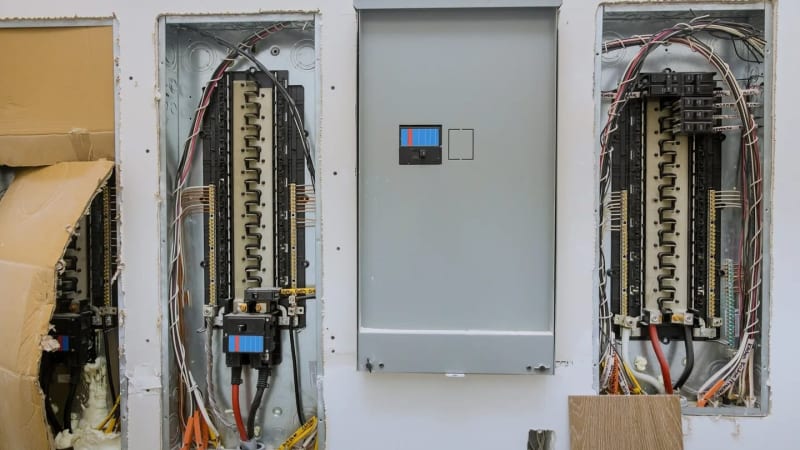
When a circuit breaker keeps tripping in your home, it is actively interrupting electrical current to protect wiring from overheating, appliance damage, and fire. In southeastern Wisconsin homes, repeated breaker trips typically stem from overloaded branch circuits, short circuits, ground faults, or failing breaker components. Identifying whether the trip occurs immediately upon resetting or under heavy appliance load determines whether you can safely rebalance circuits or require a licensed electrician.
What Causes a Circuit Breaker That Keeps Tripping?
Circuit breakers act as automatic switches in your main panel, protecting branch wiring from overcurrent. When current exceeds safe thresholds, the breaker trips to cut power before conductors overheat.
When a breaker trips repeatedly, your electrical system is flagging an ongoing condition rather than an isolated glitch. The most common underlying causes include:
- Overloaded branch circuits - Drawing more power than a circuit is designed to handle, commonly caused by running multiple high-draw appliances simultaneously on one line.
- Direct short circuits - An energized hot wire contacting a neutral conductor or another hot wire, causing an immediate current spike that trips the breaker instantly.
- Ground fault hazards - Current leaking from a hot wire into a ground conductor, metal junction box, or nearby plumbing, posing severe shock risks in damp areas.
- Arc fault conditions - Damaged or loose wiring creating intermittent sparks behind walls, which modern AFCI breakers detect and shut off to prevent framing fires.
- Worn or defective breakers - Aging internal springs and bi-metallic strips losing calibration over years of service, leading to nuisance tripping under normal household use.
Regional weather in southeastern Wisconsin frequently triggers these issues. Sub-zero winters lead homeowners to run portable space heaters, placing sustained demand on older wiring. In summer, central air conditioning compressor startups strain panels. When a circuit operates near capacity, any added draw trips the breaker.
Why Does a Breaker Trip with Nothing Plugged In?
One common puzzle is a breaker that trips with nothing plugged into wall receptacles. When every portable appliance is unplugged and the breaker trips immediately upon resetting, the issue lies within permanent wiring or the panel itself.
Even when all wall outlets are empty, several components remain connected to the circuit:
- Hardwired lighting and fixtures - Ceiling fans, recessed canned lights, hardwired smoke alarms, and bathroom exhaust fans stay continuously connected to branch conductors.
- Concealed mechanical equipment - Built-in dishwashers, garbage disposals, furnace blowers, and sump pumps often share branch circuits with living area receptacles.
- Physical conductor damage inside walls - Rodents chewing wire insulation, moisture corroding junction boxes, or drywall screws piercing cables during renovations cause direct shorts.
- Degraded outlets and wall switches - Backstabbed terminal connections can loosen over time, and cracked receptacle bodies can allow live conductors to touch grounded boxes.
- Internal breaker failure - The circuit breaker mechanism itself can fail internally, suffering from weakened springs or damaged busbar clip connections.
Locating a fault on an unloaded circuit requires professional diagnostic equipment. A licensed electrician uses insulation resistance testers and digital multimeters to isolate branch lines, check conductor continuity, and inspect service panel circuit breaker hardware to pinpoint hidden damage.
How Do You Safely Diagnose and Reset a Tripped Breaker?
Troubleshooting a tripped circuit breaker requires care to prevent electric shock and avoid equipment damage. Never force a breaker handle to stay on if it resists or trips immediately, as overriding this safety feature can overheat wiring.
Follow these consecutive steps to safely inspect and reset a tripped breaker:
- Disconnect devices - Unplug all appliances on the affected circuit to remove load.
- Locate your panel - Open the breaker panel while standing on dry flooring.
- Spot the tripped switch - Find the handle resting between "ON" and "OFF."
- Push firmly to "OFF" - Move the handle to "OFF" until it clicks to reset the internal spring.
- Switch back to "ON" - Push the switch to "ON" while standing slightly to the side.
- Reconnect one by one - Plug devices in individually; if it trips immediately, call an electrician.
Tripped Breaker Symptoms: What Do They Mean for Your Home?
Understanding specific tripping patterns helps homeowners evaluate urgency and take appropriate safety precautions. Different symptoms point toward everyday overloads, mechanical wear, or serious fire hazards.
The following guide outlines common tripped breaker symptoms, their probable technical causes, and recommended actions:
| Symptom | Likely Underlying Cause | Urgency Level | Recommended Action |
|---|---|---|---|
| Breaker trips immediately upon being reset | Direct short circuit, ground fault, or broken conductor | Urgent | Leave breaker in the "OFF" position; call a licensed electrician immediately. |
| Breaker trips after running appliances for 15 minutes | Overloaded branch circuit exceeding its designed capacity | Moderate | Unplug high-draw devices and redistribute appliances across separate circuits. |
| Breaker trips with nothing plugged into room outlets | Hidden wiring fault, defective hardwired fixture, or failing breaker | High | Keep the breaker switched off; schedule a professional circuit inspection. |
| Breaker feels hot to the touch or smells like burning plastic | Dangerous conductor overheating, loose busbar clip, or arcing | Emergency | Turn off the circuit immediately if safe; call for emergency electrical service. |
| Breaker produces buzzing or humming sounds at the panel | Loose connection, internal arcing, or severe mechanical failure | Emergency | Do not touch the breaker; contact an emergency electrician without delay. |
| Breaker trips during heavy rainstorms or rapid snowmelt | Water entering exterior conduits, outdoor outlets, or the service mast | High | Leave the circuit de-energized until outdoor fixtures dry and are inspected. |
Call (262) 235-5444 or request a callback to have Incan Electric diagnose your electrical panel and resolve recurring circuit breaker trips.
When Is a Tripping Breaker an Electrical Emergency?
While an occasional trip from an overloaded outlet is easily solved, repeated trips with heat or noise signal severe hazards. Overheated conductors inside walls can reach extreme temperatures, creating fire risks.
You should treat a tripping circuit breaker as an urgent situation and contact an emergency electrician if you encounter any of these warning signs:
- Visible scorching or melted plastic - Dark discoloration, soot marks, or melted plastic around outlet covers, switches, or panel breakers indicate severe overheating.
- Persistent burning odors - An acrid, fishy, or chemical smell near the panel or along baseboards indicates that wire insulation is actively burning.
- Audible buzzing, popping, or sizzling - Electrical components should operate silently; crackling or humming sounds indicate arcing across loose connections.
- Breakers that refuse to reset - A switch that repeatedly snaps off against your hand signals an active short circuit that must not be forced.
- Flickering lights paired with breaker trips - House-wide dimming or lights surging across unrelated rooms can indicate a failing neutral or damaged service entrance cable.
If you see smoke or sparks, evacuate and call emergency services. When safe, turn off the main service disconnect. For storm-damaged service masts or flooded basements, our team coordinates utility disconnects and reconnects with We Energies.
When an older home suffers repeated trips across multiple circuits, the underlying problem is often an undersized electrical service. Many older homes operate on 60-amp or 100-amp panels, obsolete split-bus boxes, or problematic Federal Pacific and Zinsco equipment. In these cases, completing an electrical panel upgrade to modern 200-amp service provides the capacity and safety modern households require.
Where Do We Do This Work in Southeastern Wisconsin?
Incan Electric provides electrical troubleshooting, panel repairs, and emergency service across southeastern Wisconsin. Our licensed technicians serve homeowners and property managers throughout Milwaukee, Waukesha, Racine, Kenosha, Ozaukee, and Washington counties. We work regularly in communities including Milwaukee, Kenosha, Waukesha, West Allis, Wauwatosa, Menomonee Falls, and New Berlin.
Housing throughout our service area presents distinct electrical challenges. In Milwaukee, West Allis, and Wauwatosa, thousands of historic duplexes and 1920s bungalows retain original knob-and-tube runs or ungrounded branch circuits. Built for modest lighting loads, these systems struggle under modern appliances, microwave ovens, and EV chargers.
In suburban areas like Menomonee Falls, New Berlin, Brookfield, and Waukesha, mid-century ranches frequently rely on original 100-amp panels that lack space for central air, home offices, or basement subpanels. Near Lake Michigan in Racine and Kenosha, homes endure intense lake-effect blizzards and summer storms requiring dependable heating circuits and exterior weatherproofing.
Our real project experience reflects the variety of electrical demands across southeastern Wisconsin:
- Emergency service and mast rebuilds - Rebuilding storm-damaged overhead masts, meter sockets, and main panels in Eagle, Kenosha, Union Grove, Burlington, Brookfield, West Allis, Wauwatosa, and Menomonee Falls.
- Electrical panel and service upgrades - Upgrading obsolete panels to modern 200-amp service in Racine, West Allis, Milwaukee, South Milwaukee, and Oak Creek, along with mobile home subpanel work in Waukesha.
- Electric vehicle charger installations - Installing dedicated Level 2 EV charging circuits in Kenosha, Bristol, Milwaukee, West Allis, and Saukville.
- Whole-home rewiring projects - Replacing knob-and-tube wiring in Mequon, rewiring duplexes in West Allis, and completing residential rewiring in Milwaukee, including a triplex service rebuild.
- Commercial electrical troubleshooting - Completing flood rehabilitation in Milwaukee, dental clinic wiring in Kenosha, office renovations in Pewaukee, lumberyard LED pole lighting in West Milwaukee, restaurant and bank heaters in Wauwatosa, commercial light poles in Brookfield, and 480V service in Salem Lakes.
- Standby generators and interlocks - Installing manual transfer interlocks and standby generators in Belgium, Kenosha, Union Grove, and Muskego.
- Circuits, lighting, and safety inspections - Performing branch circuit diagnostics, pool bonding tests, and electrical inspections in Kenosha, Racine, Milwaukee, Wauwatosa, Bristol, Bayside, and West Allis.
Every repair and installation complies with the NFPA 70 National Electrical Code. In Wisconsin, the Wisconsin DSPS electrical program enforces an electrical code (SPS 316) based on the 2023 NEC with Wisconsin amendments, from September 1, 2026. Incan Electric pulls all required municipal permits, coordinates utility disconnects with We Energies, and meets local building inspectors to guarantee code compliance.
Frequently Asked Questions
Can I reset a tripped circuit breaker more than once?
You can safely attempt to reset a tripped breaker one time after unplugging connected appliances. If the breaker trips again immediately or trips repeatedly over several days, do not continue resetting it. Repeatedly resetting a breaker into an active electrical fault can damage conductor insulation, degrade breaker internal contacts, and significantly increase the risk of an electrical fire.
Why does my circuit breaker feel warm to the touch?
A circuit breaker should operate at ambient room temperature or feel only faintly warm under normal load. If a breaker feels noticeably hot, it indicates severe current overload, loose busbar clip connections, or internal contact oxidation creating high electrical resistance. Switch off the affected circuit immediately and have a licensed electrician inspect the panel enclosure to prevent heat damage.
What is the difference between a standard breaker, a GFCI, and an AFCI?
A standard thermal-magnetic circuit breaker protects wiring against overloads and direct short circuits. A Ground Fault Circuit Interrupter (GFCI) detects microscopic current leakage to ground to prevent lethal electric shocks, particularly in wet areas like kitchens and bathrooms. An Arc Fault Circuit Interrupter (AFCI) detects subtle electrical sparking from damaged wires or loose connections to prevent house fires in living spaces.
How do I know if the breaker itself is bad or if the wiring is faulty?
A failing circuit breaker may show physical scorch marks, refuse to latch into position mechanically, or trip under minimal load even on a tested circuit. Conversely, a wiring fault typically causes the breaker to trip instantly upon resetting or whenever a specific switch or outlet is energized. A licensed electrician uses specialized multimeters and circuit analyzers to isolate the panel from branch wiring.
Ready to Resolve Your Repeated Circuit Breaker Trips?
Persistent circuit breaker trips are your electrical system's warning that something is wrong. Ignoring recurring trips or forcing a stubborn breaker handle compromises your family's safety and risks extensive property damage. Incan Electric provides prompt, professional diagnostic troubleshooting and code-compliant repairs across southeastern Wisconsin. Our licensed technicians bring 5+ years of hands-on experience, clear communication, and complete municipal permitting to every service visit.
Call Incan Electric at (262) 235-5444 or schedule a service visit online to resolve your tripping circuit breakers today.